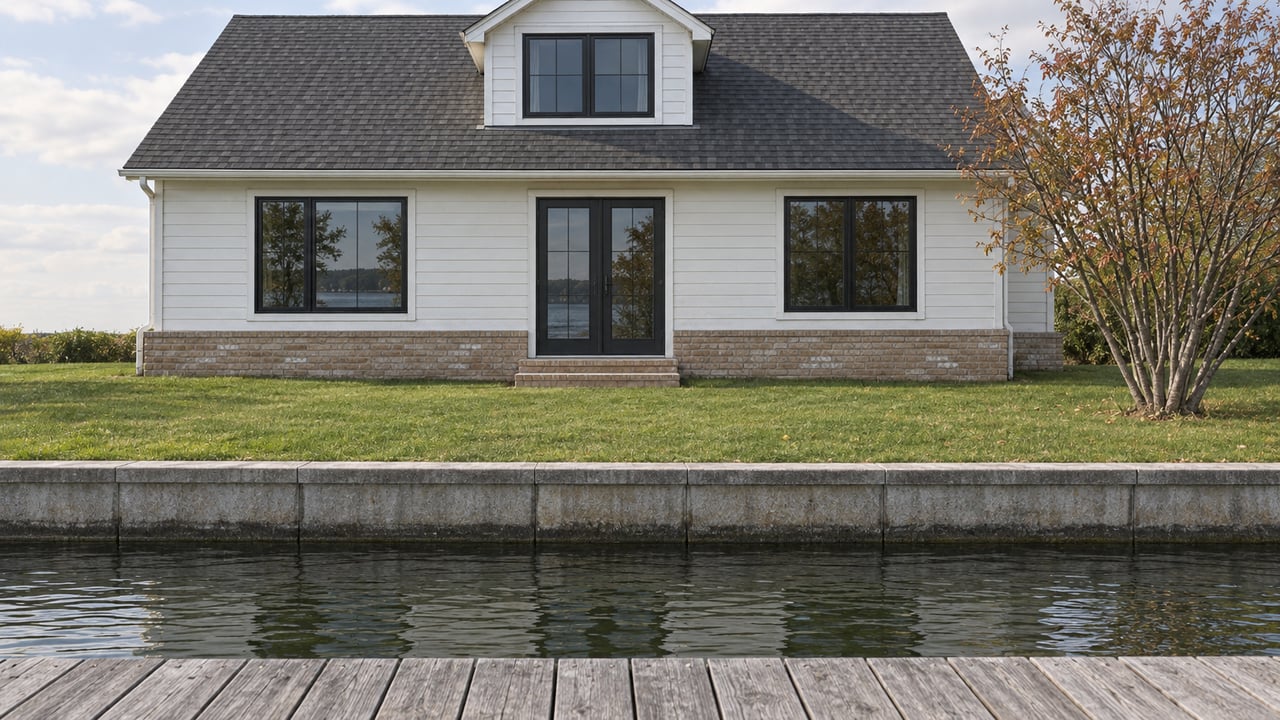
Near Silver Lake, the Septic Problem Is Usually a Setback Problem
October 1, 2026
October 1, 2026
"Steep topography or septic and well locations sometimes make larger setbacks infeasible."
— Steve Snyder, as quoted in Citizen Portal's report
That line came from Steve Snyder, representing several property owners at a Kosciusko County zoning hearing in July 2026. He was explaining, case after case, why a porch, a deck, or a pond could not simply be shifted back the required distance from the water. The land would not allow it. The septic system was already there.
If you are buying or renovating an older cottage near Silver Lake, Hill Lake, Diamond Lake, or McClures Lake, that sentence is worth sitting with. Most advice about lake property warns you to check the septic tank's condition. Fewer guides mention that the tank's location, not its condition, is often what actually stands between you and the renovation you had in mind.
Kosciusko County's zoning ordinance sets a 35-foot setback from the high bank or shoreline for most structures. The one real exception applies when the water body sits entirely inside the owner's own property lines, which covers a private pond, not a shared lake like Silver Lake or its smaller neighbors. Many of the cottages ringing these lakes went up decades before that 35-foot line existed, sitting far closer to the water than the current ordinance would ever approve for new construction.
The county's own hearing record from recent hearings shows how often that gap surfaces. As Citizen Portal reported, at the July 2025 hearing officer meeting, the county approved reconstruction of a lake residence at 16.9 feet from the measured water edge, well inside the 35-foot standard, after staff determined the real trigger was a drainage channel on the neighboring lot rather than the house itself. The same meeting approved a gazebo that cantilevers out over the water, conditioned on a written or verbal no-objection letter from the Indiana Department of Natural Resources, and widened lake stairs built closer to the water and roadway than the ordinance allows, which required an after-the-fact permit and a $125 fee. By March 2026, Citizen Portal reported that a covered deck on a lot platted before 1975 was approved at 6.39 feet from the water, with the neighboring owners signing off in writing.
These are different properties with different requests, but they describe the same underlying situation: a shoreline lot laid out before the modern setback rule.
Snyder's testimony is the part worth reading twice. He was not describing one unusual lot. He was describing the standard geometry of a small lake cottage lot, where the buildable ground, the septic system and drainfield, and the 35-foot protected strip along the water all compete for the same narrow band of land. On a lot that might only run 80 or 100 feet deep from road to shoreline, there often is no version of the project that keeps the structure at 35 feet and leaves the septic system where it has functioned for decades. Something has to give, and the variance hearing is where that gets decided case by case rather than assumed in advance.
The standard is 35 feet. Here is how close the board actually allowed four recent projects to get, and what it took to get there.
| Project | Approved distance from water | What made it possible |
|---|---|---|
| Home reconstruction (July 2025) | 16.9 feet | Neighboring drainage channel accepted as the real constraint; side setbacks still had to be met |
| Cantilevered gazebo (July 2025) | Extends over the water | Written or verbal no-objection from the Indiana DNR |
| Widened lake stairs (July 2025) | Closer to water and road than standard | After-the-fact permit plus a $125 fee |
| Covered deck, pre-1975 lot (March 2026) | 6.39 feet | Signed acknowledgment from neighboring owners |
None of these were denied. All of them needed something beyond a standard building permit before they could proceed.
The cases above involve reconstruction, a gazebo, widened stairs, and a deck.
Plan for that timeline before you plan the renovation. A variance request goes to the Area Plan Commission or the zoning board, and anything reaching over the water may need a separate letter from the DNR. None of that happens in a single afternoon.
When a project touches both the setback line and the septic system, it usually means two separate county offices, not one. The Area Plan Commission handles the zoning variance. The Kosciusko County Health Department, at 100 W. Center Street in Warsaw, handles the septic and well permit itself, since any new installation, repair, or well replacement requires its own approval through that office regardless of what the zoning board decides.
According to Septic Tank Hub, Indiana's general septic rule sets a minimum 50-foot setback between a septic system and a private well. For a specific property, the Health Department is the right first call. What does not change with any of this is the disclosure obligation.
The Silver Lake Kosciusko County Conservation Foundation exists specifically to promote and enhance water quality in Silver Lake, North Little Lake, and South Little Lake, and to work with property owners on stormwater and watershed issues affecting those three connected bodies of water. The county's caution around setbacks and septic placement is not paperwork for its own sake. It is the same narrow shoreline, repeated around dozens of small lots, that the foundation is trying to protect.
A few questions are worth answering before you assume a lake cottage can be expanded or its septic system moved:
A lake cottage near Silver Lake can be a very good decision. It just tends to reward the buyer who checks the setback line before falling for the porch. If you are weighing a purchase or a renovation on one of these lots, Billie Shively can walk through what the county's records actually show for a specific property before you commit to a plan that the shoreline won't allow.
This article is general information, not legal, tax or financial advice. Consult a qualified professional about your situation.

Maximize Its Value
Not All Real Estate Agents Offer the Same Services. Discover What to Ask, What Benefits to Expect, and How to Find an Agent Who Truly Puts Your Needs First.

Maximize Its Value
Is Now the Right Time to Buy or Sell? Discover What the Latest Housing Statistics Reveal About Home Values, Buyer Demand, and Opportunities in Warsaw, Kosciusko County… Read more

Maximize Its Value
Behind on Mortgage Payments? Discover Ways to Stop Foreclosure, Protect Your Home Equity, and Make Informed Decisions About Your Financial Future with Guidance from Wa… Read more


Maximize Its Value
Is it a buyer’s or seller’s market? Explore the latest Warsaw and Kosciusko County housing trends, home prices, mortgage rates, inventory, and what today’s market mean… Read more

Maximize Its Value
Discover 5 potential benefits of seller financing for Indiana homeowners, including attracting more buyers, creating income, increasing flexibility, and selling your h… Read more
Known for her elevated standards and thoughtful strategy, Billie Shively offers white-glove representation tailored to discerning buyers and sellers. From presentation to closing, she ensures each property is positioned to stand out and perform at the highest level.